A first step is a big day in every family. And right after it, most parents rush to the shop: the child is walking, so they must need shoes. In fact, there's no need to hurry.
At home — barefoot
While a child is learning to walk, the best "shoe" they have is their own foot. Barefoot, they feel the floor better, stand more steadily and learn to balance faster. At home, on a warm floor, they don't need shoes. If the floor is cold, non-slip socks are enough.
When it's time for shoes
You'll need first shoes once your child stands on their own, walks by themselves and starts walking outdoors. In the garden, the park or the street, feet need protecting — from cold, wet ground and sharp objects. The right time to buy shoes depends not on age but on how confidently your child walks.
What first shoes should be like
Many people think first shoes should be stiff and high-topped to "hold" the ankle. In reality, a child's foot doesn't need holding — it needs freedom. German researchers measured how children walk and found that ordinary shoes restrict how the foot moves, while in thin, flexible shoes the movement comes close to walking barefoot.
You can recognise good first shoes by a few signs:
They bend in every direction — the sole folds and twists easily in your hands.
A wide toe box — the toes spread freely inside.
A thin, flat sole, with no heel.
Light — they don't weigh the foot down.
A good fit — with Velcro or laces, so the foot doesn't slide around inside.
What to avoid
Stiff shoes whose sole won't bend in your hands.
Second-hand shoes — the sole and insole have already taken the shape of the previous owner's foot.
Shoes "to grow into" — in shoes that are too big, a child stumbles and grips them with their toes.
Narrow or short shoes. In one study, 88.8% of the indoor shoes of 858 preschoolers were too short — so check the size regularly.
Froddo shoes for first steps
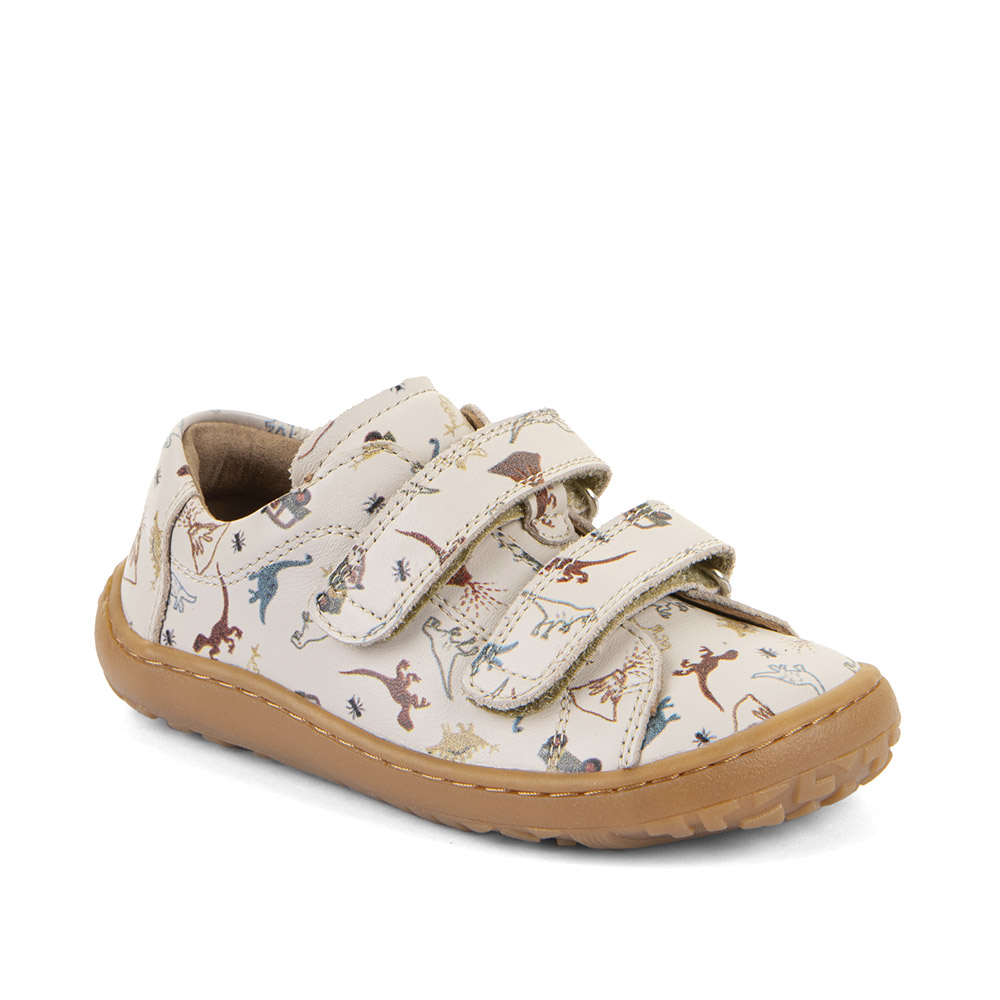
In our catalogue you'll also find Froddo Barefoot First Step models made for first steps: soft leather, a thin flexible sole and a wide toe box. Every shoe's page has a size calculator — enter your child's foot length and it will pick the right size for you.
And the main thing: barefoot at home, light and flexible shoes outdoors. Little feet need nothing more.
Sources
Wolf S. et al. Foot motion in children shoes — a comparison of barefoot walking with shod walking in conventional and flexible shoes. Gait & Posture, 2008. doi.org/10.1016/j.gaitpost.2007.01.005
Klein C. et al. Increased hallux angle in children and its association with insufficient length of footwear: a community based cross-sectional study. BMC Musculoskeletal Disorders, 2009. doi.org/10.1186/1471-2474-10-159